
How to Use AI Content Checkers Safely to Improve Your Writing (2026)
AI writing tools have become common for bloggers, freelancers, students, and online businesses. They can help with brainstorming, editing, research, and getting a first draft on the page.
But one question often comes up after using them:
Will this content be detected as AI-written?
That’s where AI Content Checkers come in.
These tools analyze text and provide an estimate of whether writing appears to have been produced by AI. Some also provide additional information about writing patterns, readability, originality, or possible issues.
However, there is an important difference between checking your writing and trying to manipulate a detector.
A detector score should not be treated as a final verdict about who wrote something. Recent research shows that detector performance can vary depending on the type of text, especially when human and AI writing are mixed.
For bloggers, the smarter approach is to use these tools as part of a quality-checking workflow rather than chasing a particular percentage.
What Are AI Content Checkers?
AI content checkers are software tools designed to estimate whether a piece of text has characteristics associated with AI-generated writing.
Depending on the platform, you may see a percentage, probability score, or classification.
For example, a tool might report that a piece of writing appears:
- Mostly human-written
- Likely AI-generated
- Mixed or uncertain
- Requires further review
The exact scoring system differs between tools.
That’s why you shouldn’t assume that one detector’s result represents an absolute truth.
A recent 2026 study examining multiple detection tools found that performance could change substantially when text was hybrid or had been modified by humans. The researchers concluded that detector results require context rather than being treated as a simple yes-or-no classification.
Why People Use AI Content Checkers
There are several legitimate reasons to check your content before publishing or submitting it.
1. To Review AI-Assisted Writing
If you used an AI tool to brainstorm ideas or create an early draft, a checker can give you another signal about how the finished text is being classified.
This can encourage you to review the writing more carefully.
2. To Find Writing That Sounds Too Generic
Sometimes AI-assisted writing has a predictable structure.
You might notice:
- Repeated sentence patterns
- Generic introductions
- Excessive headings
- Repetitive explanations
- Unnecessary filler
- Overly formal wording
Even if a detector doesn’t flag the content, these are good reasons to edit it.
The goal should be writing that sounds clear, useful, and appropriate for your audience.
3. To Check Your Own Human-Written Content
This is one of the most important reasons to understand detector limitations.
A human-written article can sometimes receive an AI-related score.
Research published in 2026 continues to report concerns about the accuracy, consistency, and fairness of AI detection systems in different writing environments.
So if a checker says your original writing looks like AI, don’t immediately assume that the writing is bad or that you did something wrong.
Review the actual content instead.
AI Detection Scores Are Not the Same as Proof
This is probably the most important lesson in this article.
An AI detector produces a prediction, not a magical record of how a document was created.
Different tools can produce different results.
Even the same piece of content may receive different scores after editing, because the wording and structure have changed.
A 2026 study comparing five detection tools found strong performance on fully human versus fully AI-generated samples but substantially weaker performance on hybrid and humanized text. The researchers therefore recommended interpreting scores according to context rather than using them as definitive classifications.
So don’t build your entire writing strategy around getting a particular detector score.
A Better Way to Use AI Content Checkers
Instead of thinking:
“How do I get the detector to say 0% AI?”
think:
“How can I make this article clearer, more useful, and more natural?”
That’s a much better goal for a blogger.
Start by reading the article yourself.
Look for sections that feel:
- Repetitive
- Too general
- Overly formal
- Unclear
- Full of unnecessary words
- Missing practical examples
- Written for search engines instead of readers
Then improve those sections.
For example, instead of writing:
AI tools can help users improve productivity and achieve better results in various tasks.
You could make it more useful:
A good AI writing tool can help you turn a rough idea into an outline, clean up a draft, and find sections that need more detail.
The second version gives the reader something concrete.
Don’t Rewrite Good Content Just to Change a Detector Score
This is where many writers make a mistake.
They run an article through a checker, see a high AI probability, and start changing perfectly good sentences simply to lower the score.
That can make the article worse.
You may end up with:
- Awkward wording
- Forced synonyms
- Strange sentence structures
- Unnatural paragraphs
- Poor readability
That’s not a good trade.
Your first priority should be quality and accuracy.
Google’s current Search guidance also emphasizes creating useful content rather than producing large amounts of low-value content for the purpose of manipulating search rankings. Its spam policies specifically warn against scaled content created primarily to manipulate search results without providing value to users.
Quick Overview
A safe AI-content checking workflow looks like this:
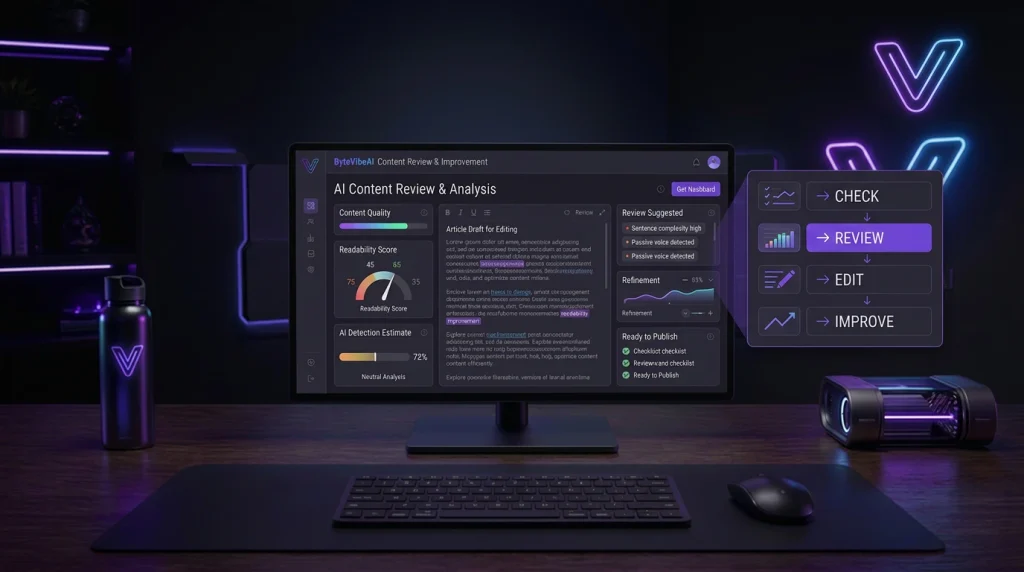
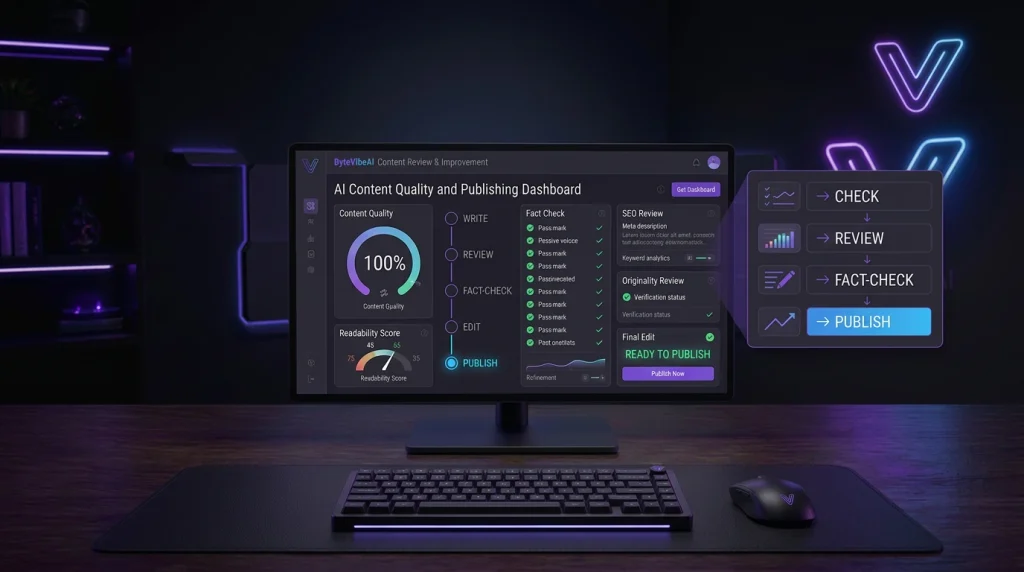
Write → Review → Check → Improve → Fact-check → Publish
Not:
Generate → Rewrite repeatedly → Chase 0% → Publish
The first workflow puts the reader first.
And that’s exactly what you want for a long-term blog.
If you understand what an AI content checker actually does, the next step is learning how to use one without becoming obsessed with its percentage.
A checker can be useful as a review tool, but it shouldn’t control every sentence you write.
The goal is simple: create content that is accurate, helpful, easy to read, and genuinely useful to your audience.
Step 1: Finish Your Draft First
Don’t run your content through a detector after every paragraph.
Write the complete draft first.
This gives you a chance to see the article as a whole instead of constantly changing sentences based on a score.
Once your draft is finished, read it from the beginning.
Look for anything that feels repetitive or doesn’t sound like something you would naturally say.
Step 2: Run the Article Through a Checker
Now you can use an AI content checker as an additional review step.
Paste your article into the tool and examine the result.
Don’t panic if the tool gives you a high AI probability.
Instead, ask:
“Which parts of this article actually need improvement?”
Some tools may highlight particular sentences or sections. These can be useful places to start reviewing.
But don’t automatically rewrite every highlighted sentence.
A detector can be wrong.
Step 3: Read the Flagged Sections Yourself
Suppose a checker highlights this sentence:
AI technology provides numerous advantages for users who want to improve their overall productivity.
Ask yourself whether it sounds natural.
It is grammatically correct, but it’s also vague.
You could rewrite it as:
AI can help you finish repetitive tasks faster, organize information, and spend more time on important work.
The second version is more specific and useful.
Notice that the improvement isn’t about “beating” a detector.
It’s about making the writing better.
Step 4: Add Real Examples
One of the easiest ways to make an article more useful is to include practical examples.
Instead of saying:
AI writing tools can help bloggers create better content.
Explain how:
A blogger can use an AI tool to turn five rough ideas into an article outline, then manually add research, examples, opinions, and useful details.
Now the reader understands how the tool fits into an actual workflow.
Examples also make your content more informative instead of relying on broad statements.
Step 5: Add Your Own Analysis
If you’re writing a review or comparison article, don’t simply repeat what a tool’s website says.
Add your own analysis.
For example, discuss:
- Who the tool is best for
- What its free version offers
- Where it may be limited
- How easy it is for beginners
- What type of content it works well with
- When another tool might be a better choice
This creates more useful content for readers.
Don’t Try to Manipulate Every Detector
There are many websites and services that promise to make text “undetectable.”
The problem is that detector scores can vary significantly between tools.
A sentence that one checker considers AI-written may be classified differently by another.
Research also shows that AI detectors can struggle with mixed human-and-AI writing. That makes chasing a perfect score an unreliable strategy.
Instead of repeatedly changing words to manipulate a score, focus on improving the actual article.
What If Your Human-Written Article Gets Flagged?
Don’t immediately rewrite it.
First, check the content yourself.
Ask:
Is the information accurate?
Does the writing sound natural?
Are the examples useful?
Does every paragraph have a purpose?
Does the article actually answer the reader’s question?
If the answer is yes, a detector score by itself isn’t a strong reason to destroy a good article.
This is especially important because false positives can happen.
Human Editing Is More Valuable Than Random Rewriting
If you’re using AI as part of your writing process, don’t simply replace words with random synonyms.
For example:
Original:
This tool can help you improve your writing efficiency.
Forced rewrite:
This instrument can assist you in enhancing your literary productivity.
The second sentence sounds worse, not better.
A natural edit would be:
This tool can help you write faster and spend less time fixing repetitive problems.
That’s the kind of editing that improves content.
Build a Personal Writing Style
Your writing style becomes stronger when you consistently make your own choices.
You can develop a recognizable style by:
- Using examples from your topic
- Explaining technical ideas simply
- Sharing practical observations
- Keeping paragraphs focused
- Avoiding unnecessary filler
- Writing for a specific audience
- Using a consistent tone
For a technology blog, this can make your articles easier to read and more memorable.
Your goal isn’t to sound complicated.
Your goal is to sound clear and confident.
A Simple AI Content Checking Workflow
Here’s a practical workflow you can use for blog posts:
1. Choose your topic
Know exactly what question you’re answering.
2. Research the subject
Collect reliable information before writing.
3. Create your first draft
Get the main ideas onto the page.
4. Add useful details
Include examples, comparisons, explanations, and practical advice.
5. Edit manually
Remove repetition and improve unclear sentences.
6. Use an AI content checker
Treat its result as one additional signal.
7. Review questionable sections
Don’t automatically rewrite everything the tool highlights.
8. Fact-check
Make sure claims, statistics, product details, and dates are accurate.
9. Final readability check
Read the article like a normal visitor.
10. Publish
If the content is useful and meets your quality standards, don’t keep rewriting it just to chase a detector percentage.
What About SEO?
AI detection and SEO are two different things.
Getting a low AI-detection score does not automatically mean an article will rank well.
Likewise, a high detector score doesn’t automatically mean an article is poor.
For SEO, concentrate on things that actually help the reader:
- Search intent
- Useful information
- Clear headings
- Accurate answers
- Good internal linking
- Helpful examples
- Original analysis
- Strong page experience
Google’s guidance focuses on helpful, reliable content and warns against creating content primarily to manipulate search rankings.
That makes a quality-first workflow a much safer long-term approach.
By now, you know that an AI Content Checker can be useful, but its score should never become the only thing you care about.
The best approach is to use detection tools as one part of a larger editing process. Your real goal should be content that is accurate, original in its ideas, useful to readers, and natural to read.
Current research also supports a more careful approach. A 2026 study found that detector results need context and that performance can change considerably with hybrid human-and-AI writing.
6 Mistakes to Avoid When Using AI Content Checkers
1. Chasing a 0% AI Score
This is probably the biggest mistake.
If you keep rewriting an article until a detector reports 0%, you may end up damaging the quality of the writing.
A detector score is an estimate, not a writing-quality score.
Instead, ask:
Does this article genuinely help the reader?
That question matters much more.
2. Replacing Words With Random Synonyms
Don’t use unusual words simply because a detector highlighted a sentence.
For example:
Poor edit:
This tool facilitates the optimization of your writing workflow.
Natural edit:
This tool can help you organize your writing process and finish repetitive tasks faster.
The second sentence is clearer and more useful.
3. Rewriting Every Flagged Sentence
A detector might highlight a completely normal sentence.
That doesn’t automatically mean you need to change it.
Read the surrounding paragraph first. If the sentence is accurate, clear, and fits your writing style, there may be no reason to rewrite it.
4. Trusting One Detector
Different AI detection systems use different methods and can produce different results.
Recent reporting has shown that even newer detectors can disagree on mixed human-and-AI content, particularly when human editing is involved.
So don’t treat one percentage as absolute proof.
5. Ignoring Your Own Writing Style
Your website should have a recognizable voice.
For a technology blog, that might mean:
- Simple explanations
- Short paragraphs
- Practical examples
- Clear comparisons
- Honest pros and cons
- Helpful recommendations
These things make an article more useful regardless of what a detector reports.
6. Forgetting to Fact-Check
A low AI-detection score doesn’t make incorrect information acceptable.
Before publishing, verify:
- Product features
- Pricing
- Dates
- Statistics
- Company information
- Software availability
- Technical claims
Accuracy should always come before detector scores.
How to Make AI-Assisted Content More Useful
If AI helped you create an early draft, add value during editing.
Don’t simply change words.
Add information that actually helps the reader.
For example, if you’re reviewing an AI writing tool, explain:
Who should use it?
A student may need something different from a freelance copywriter.
What is the free version like?
Readers want to know whether they can actually use the tool without paying.
What are its limitations?
A trustworthy article should mention weaknesses as well as benefits.
What is a better alternative?
Sometimes another tool may be a better fit for a particular reader.
These additions make your content more useful than a generic list of features.
Keep Evidence of Your Writing Process
If you’re concerned about proving authorship, your writing process can be more useful than a detector percentage.
Keep things such as:
- Original notes
- Research documents
- Article outlines
- Draft versions
- Editing history
- Sources
- Your own screenshots
- Published revisions
This creates a record of how the article developed.
For professional blogging, that’s a much healthier workflow than repeatedly modifying text to satisfy an automated score.
What Should You Do If Two Detectors Disagree?
Don’t panic.
For example, imagine:
Checker A: 18% AI
Checker B: 72% AI
That large difference is a reminder that the numbers are estimates.
Go back to the article and evaluate the actual writing.
Check whether the content is:
- Accurate
- Clear
- Original in its analysis
- Useful
- Properly researched
- Appropriate for the intended audience
If the article is strong, don’t automatically rewrite it just because one tool produced a high percentage.
Can AI Content Checkers Guarantee Human Writing?
No.
No detector should be treated as a perfect authorship test.
The technology continues to improve, but detection remains an evolving area. Current research and reporting show that performance depends on factors such as text type, length, amount of AI assistance, and the detector being used.
That’s why responsible use matters.
FAQs
Can AI Content Checkers detect every AI-written article?
No. Detection systems can miss some AI-generated content, and their results can change depending on how the text was produced or edited.
Can human writing be flagged as AI?
Yes. False positives are possible. That’s one reason a detector score shouldn’t be treated as conclusive evidence.
Should bloggers use AI detectors before publishing?
They can, especially as an additional review step. But bloggers should focus primarily on accuracy, usefulness, originality, readability, and search intent.
Should I rewrite an article if the detector gives it a high score?
Not automatically. First read the article yourself and identify genuine problems such as repetition, vague explanations, weak examples, or unnatural wording.
Is humanizing AI text the same as improving content?
No. Simply changing wording to make text appear more human doesn’t necessarily make it better. Real improvement comes from adding useful information, original analysis, accurate examples, and a clear writing style.
What is the safest way to use AI for blogging?
Use AI Content Checkers as a supporting tool rather than letting it replace your entire editorial process. Research the topic, create or review the draft, add your own analysis, fact-check everything important, edit carefully, and then publish useful content.
Internal Links for ByteVibeAI
Good internal-link opportunities include:
- AI Content Editing: Tools to Make AI Text Sound More Human
- How to Use AI to Rewrite Old Articles & Boost SEO Traffic
- Best Free AI Writing Tools for Bloggers and Freelancers
- Best AI Prompts for Writing Cold Outreach Emails That Get Replies
- Best Free AI Headline & Meta Description Generators for Higher CTR
Use descriptive anchor text rather than repeatedly using “click here.”
Final Thoughts
AI Content Checkers can be useful when they’re treated as one part of the editing process, not as the final judge of your writing.
A detector score can give you something to investigate, but it cannot replace human judgment.
If a paragraph sounds repetitive, make it clearer. If an explanation is too general, add an example. If a claim needs evidence, research it. If the article doesn’t answer the reader’s question, improve the content.
That’s a much better strategy than endlessly changing sentences to chase a particular percentage.
For bloggers, the long-term goal should be simple:
Create content that readers find useful and trustworthy.
Use AI where it saves time, use checkers where they provide helpful feedback, and keep the final editorial decisions in your hands.