Best Free AI Headline & Meta Description Generators for Higher CTR
Getting someone to notice your blog post in search results is only half the battle. The next challenge is getting them to click.
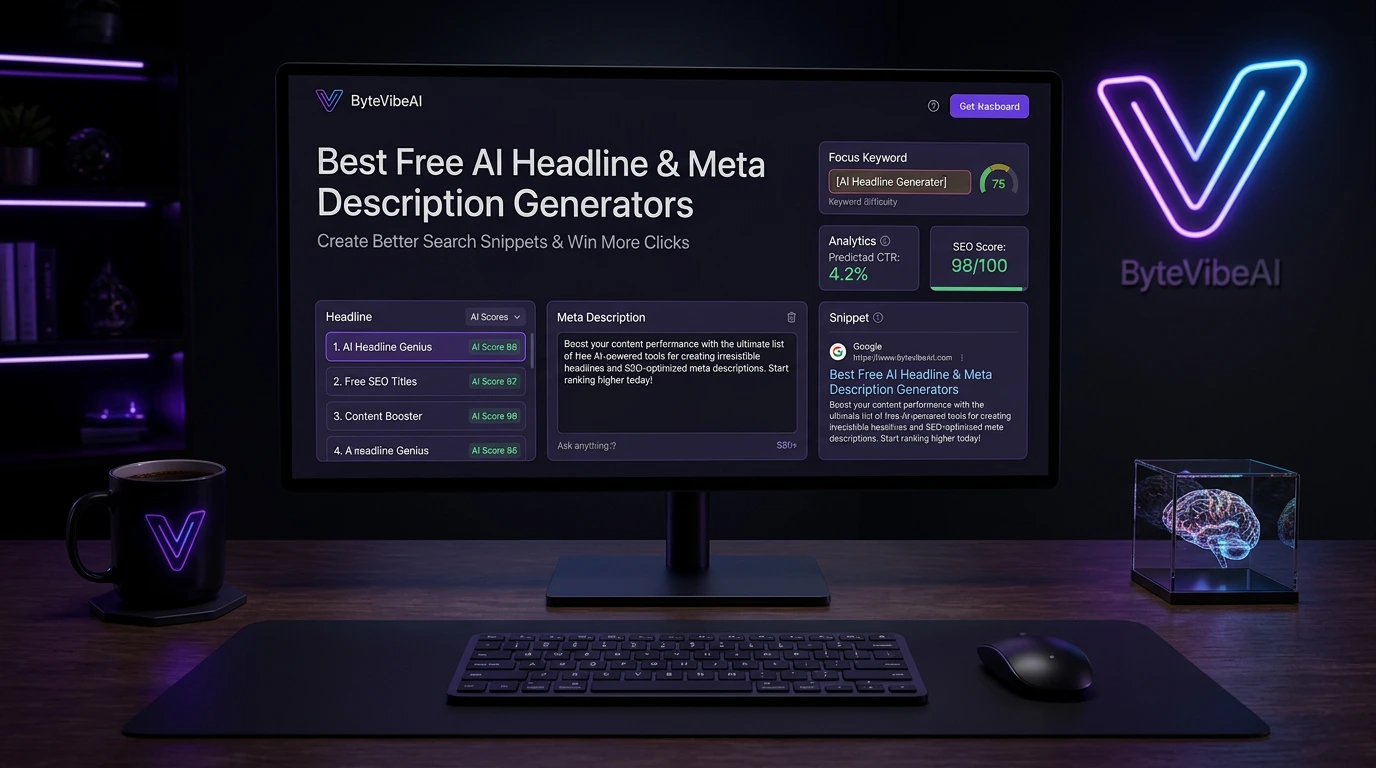
A strong headline can make your article stand out, while a clear and useful meta description can give readers a reason to visit your page. This is where Best Free AI Headline & Meta Description Generators can save time and help you create better search snippets.
Instead of writing dozens of headline ideas manually, you can use these tools to generate different options in seconds. You can then choose the best one, edit it, and make sure it actually matches your content.
For bloggers, freelancers, students, and website owners, this can make the SEO writing process much easier.
Why Headlines and Meta Descriptions Matter
Think about what happens when someone searches for something on Google.
They usually see:
- Your page title
- Your URL
- A short description
- Several competing results
Your headline needs to immediately tell the reader what they will get from your article.
For example, compare these two titles:
AI Writing Tools
and
5 Best Free AI Writing Tools for Bloggers in 2026
The second headline gives much more information. It tells the reader the number of tools, the topic, the audience, and the year.
Your meta description has a similar job. It gives searchers additional context and can make your result more appealing to click.
However, there is an important point to understand: a meta description is not a direct Google ranking factor. Google can also choose to display a different snippet from your page when it believes another section better matches the search.
So the goal should not be to “trick” Google.
The goal is to create a useful, accurate search result that makes the right reader want to learn more.
What Are AI Headline and Meta Description Generators?
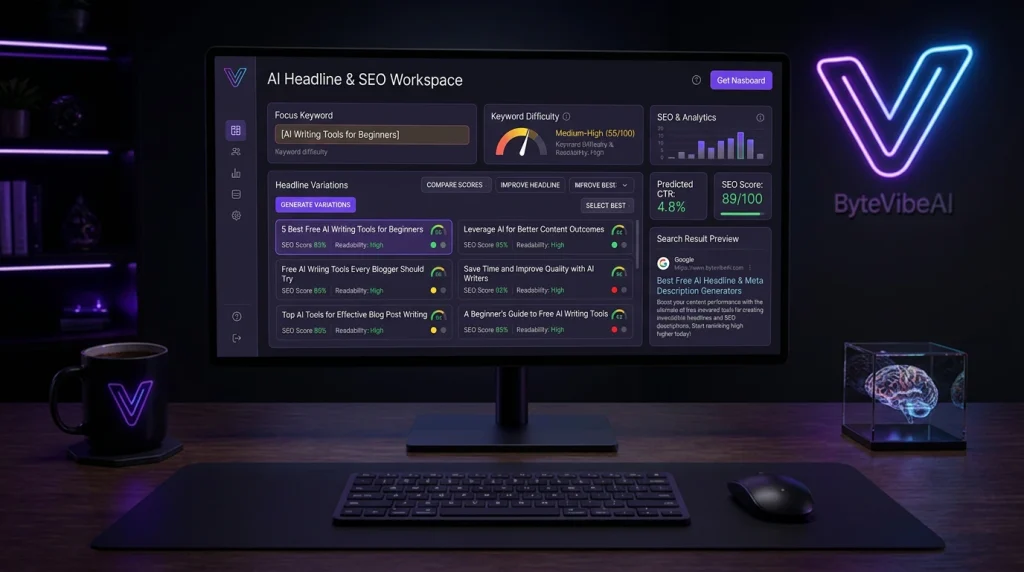
AI headline and meta description generators are online writing tools that create suggestions based on information you provide.
You might enter:
- Your main topic
- Focus keyword
- Target audience
- Content type
- Main benefit
- Desired tone
The tool then produces several headline or description ideas.
For example, if your topic is free AI tools for students, you could ask for:
10 catchy blog headlines using the keyword “free AI tools for students”
Instead of starting with a blank page, you get multiple ideas to work with.
This doesn’t mean you should publish the first suggestion automatically. A good workflow is to generate ideas, remove weak options, check keyword usage, and then edit the final version so it sounds natural.
Benefits of Using the Best Free AI Headline & Meta Description Generators
There are several reasons bloggers and content creators are using these tools.
1. They Save Writing Time
Coming up with a good headline can sometimes take longer than expected.
You may have a great article but struggle to find a title that explains the topic clearly and sounds interesting.
An AI generator can give you several starting points quickly.
2. You Get More Ideas
One headline may seem good at first, but another option might be much stronger.
AI tools can produce different approaches, such as:
- List-based headlines
- How-to headlines
- Question-based headlines
- Benefit-focused headlines
- Beginner-friendly titles
- Problem-solving headlines
Having several options makes it easier to choose the strongest one.
3. You Can Include Your Focus Keyword
SEO headlines should clearly communicate the main topic.
For example, if your focus keyword is:
Best Free AI Headline & Meta Description Generators
you can ask the tool to create headline variations while keeping that exact phrase.
This can be especially useful when you’re optimizing an article with an SEO plugin such as Rank Math.
4. They Help With Meta Description Length
Meta descriptions need to be concise because search results have limited space.
Some AI SEO tools can help keep descriptions within a practical character range and make them easier to scan.
Still, don’t focus only on character count. Clarity and usefulness matter more than forcing every description to reach a specific number.
Quick Overview of the Best Free AI Headline & Meta Description Generators
Before choosing a tool, think about what you actually need.
Some tools are better for generating creative headline ideas, while others focus more heavily on SEO titles and search snippets.
Here are some useful options worth exploring:
- Ahrefs — useful for SEO-focused content ideas and title/meta work
- Semrush — helpful for broader SEO workflows and content optimization
- Copy.ai — useful for generating multiple marketing and content variations
- Rytr — beginner-friendly for quick writing ideas
- Jasper — designed for broader marketing and content workflows
- Rank.ai — offers a dedicated free meta description generator
- Skoatch — provides title and meta description generation with SEO-oriented guidance
The exact free features offered by these platforms can change, so always check the current limits before building your workflow around one particular tool.
What Makes a Good SEO Headline?
A good headline doesn’t need to sound complicated.
It should quickly answer one simple question:
“Why should I click this result?”
Strong headlines often include one or more of these elements:
- A clear benefit
- A specific number
- A target audience
- A year when freshness matters
- A problem being solved
- A strong but accurate reason to continue reading
For example:
Weak:
AI Tools for Writers
Better:
5 Free AI Writing Tools for Bloggers and Freelancers
The second version is more specific and tells readers exactly what to expect.
But avoid exaggerated headlines that promise something your article doesn’t deliver.
A headline such as “This AI Tool Will Make You Rich Overnight” may attract attention, but it doesn’t build trust.
A better approach is to make the headline interesting and honest.
Choosing the right generator depends on what you want to create. Some tools are better for quick headline ideas, while others are more focused on SEO content and search snippets.
The good thing is that you don’t need to use every tool. Testing a few options and finding one that fits your writing process is usually enough.
7 Best Free AI Headline & Meta Description Generators
1. Ahrefs
Ahrefs is widely known for SEO research, but it also provides tools that can help with content ideas, titles, and descriptions.
It can be useful when you already have a target keyword and want to create content around a specific search intent.
For example, instead of simply asking for:
“AI writing tools”
you can work with a more specific topic such as:
“Best free AI writing tools for bloggers”
This gives you a clearer direction for your headline and content.
Best for: Bloggers and website owners who already work with SEO keywords.
2. Semrush
Semrush offers a much larger SEO platform, including content and writing features.
For bloggers, its biggest advantage is that headline and description work can be part of a wider SEO process. You can research keywords first and then use that information while creating your content.
This can help keep your headline connected to the actual search topic instead of creating a catchy title that doesn’t match what people are looking for.
Best for: SEO-focused bloggers and content marketers.
3. Copy.ai
Copy.ai is useful when you want several variations quickly.
You can provide your topic, audience, keyword, and desired tone and ask for multiple headlines.
For example:
Topic: AI productivity tools
Audience: Remote workers
Keyword: free AI productivity tools
Tone: Professional and friendly
You could then ask for 10 headline variations and select the strongest one.
Best for: Creative headline ideas and marketing-style content.
4. Rytr
Rytr is another option for generating short-form content ideas.
It’s particularly useful for beginners because you don’t need a complicated workflow. Enter your topic, select the type of content you want, and generate suggestions.
You can use it for:
- Blog titles
- Meta descriptions
- Social media copy
- Short introductions
- Content ideas
Best for: Beginners who want a simple writing assistant.
5. Jasper
Jasper is built around marketing and content creation.
Its writing features can help generate different versions of titles and promotional copy. This can be helpful when you’re trying to find a headline that communicates a clear benefit without making it unnecessarily long.
However, some advanced features may require a paid plan, so check the current availability before choosing it specifically for free use.
Best for: Marketing teams and content creators who need broader writing features.
6. Rank.ai
Rank.ai provides a dedicated free meta description generator.
You can provide information such as your target keyword and content topic, and the tool generates description variations.
This type of focused tool can be useful when you already have your headline and simply need help writing a concise search description.
Best for: Quickly creating SEO-focused meta descriptions.
7. Skoatch
Skoatch offers a title and meta description generator designed around SEO-friendly search snippets.
It can help you create title and description ideas while considering factors such as keyword placement and length.
This makes it useful when you’re preparing an article for publication and want to work on the search snippet separately from the main article.
Best for: Bloggers who want a dedicated title and meta description workflow.
How to Use AI to Create Better Headlines
You don’t need a complicated prompt.
Give the tool enough information to understand your article.
Try this:
Create 10 SEO-friendly blog headline ideas for an article about [TOPIC]. Use the focus keyword “[KEYWORD]” naturally. Keep the headlines clear, specific, and appealing. Avoid clickbait and exaggerated claims.
For example:
Create 10 SEO-friendly blog headline ideas for an article about free AI writing tools for beginners. Use the focus keyword “free AI writing tools” naturally. Keep the headlines clear, specific, and appealing. Avoid clickbait and exaggerated claims.
The important part is the instruction to avoid clickbait.
A headline should attract the right reader, not simply attract as many clicks as possible.
How to Create an SEO-Friendly Meta Description
Once your headline is ready, create the description separately.
Use a prompt like this:
Write 5 concise meta descriptions for my article. Focus keyword: “[KEYWORD]. Topic: [TOPIC]. Clearly explain the benefit of reading the article. Keep each description natural, specific, and suitable for a Google search result. Avoid keyword stuffing and false claims.
This gives you several versions instead of forcing you to accept the first result.
After generating them, check each one manually.
Ask yourself:
Does this description accurately explain what the reader will find on my page?
If the answer is yes, you’re on the right track.
Don’t Let AI Choose Everything for You
AI can generate ideas quickly, but you should still make the final decision.
Sometimes an AI-generated headline can sound impressive but fail to explain the actual article.
For example:
“10 Secret AI Tricks That Will Completely Change Your Writing”
This sounds exciting, but it may not tell the reader enough.
A clearer version could be:
“10 Free AI Writing Tips for Faster Blog Content in 2026”
The second headline is more specific and sets a realistic expectation.
That’s the approach you should use with Best Free AI Headline & Meta Description Generators: use them for ideas, then apply your own judgment before publishing.
A Simple Workflow for Bloggers
You can make the entire process much easier by following five steps:
Step 1: Choose your primary keyword.
Step 2: Generate 10–15 headline ideas.
Step 3: Select the clearest and most relevant headline.
Step 4: Generate several meta description variations.
Step 5: Edit the final title and description manually.
This takes much less time than repeatedly starting from a blank page.
And most importantly, your final headline should match the actual content of the article.
Using an AI generator is only the beginning. The quality of your final headline and meta description depends on how well you edit the suggestions.
A good search snippet should be clear, useful, and closely connected to the page.
Here are some simple ways to improve your results.
5 Common Headline Mistakes to Avoid
1. Making the Headline Too Long
A headline should communicate the main idea quickly.
Avoid adding unnecessary words just to make the title sound bigger.
Instead of:
The Complete and Absolutely Amazing List of the Best Free AI Tools That Every Beginner Should Definitely Try in 2026
try:
7 Best Free AI Tools for Beginners in 2026
The second version is much easier to understand.
2. Using Clickbait
Clickbait may get attention, but it can hurt trust when the article doesn’t deliver what the headline promises.
Avoid claims such as:
- “You Won’t Believe This”
- “The Secret Nobody Knows”
- “Guaranteed Results”
- “This Will Change Everything”
Be interesting, but stay honest.
3. Forgetting Search Intent
Before creating a headline, think about what the person searching actually wants.
Someone searching for:
best free AI writing tools
probably wants recommendations.
A headline like:
Best Free AI Writing Tools for Bloggers in 2026
matches that intent much better than:
The Future of Artificial Intelligence and Writing
The second title may sound interesting, but it doesn’t directly answer the search.
4. Stuffing Keywords
Your focus keyword should appear naturally.
Don’t repeat the same phrase several times in one title or description.
Google’s search results are written for people, so readability should always come first.
5. Making Every Title Sound the Same
AI generators can sometimes produce similar-looking headlines.
If every article on your website follows the exact same pattern, your content can feel repetitive.
Try different structures:
- 5 Best…
- How to…
- Best… for Beginners
- X Free Tools…
- A Beginner’s Guide to…
Keep the format appropriate for the topic.
How to Improve Your Meta Descriptions
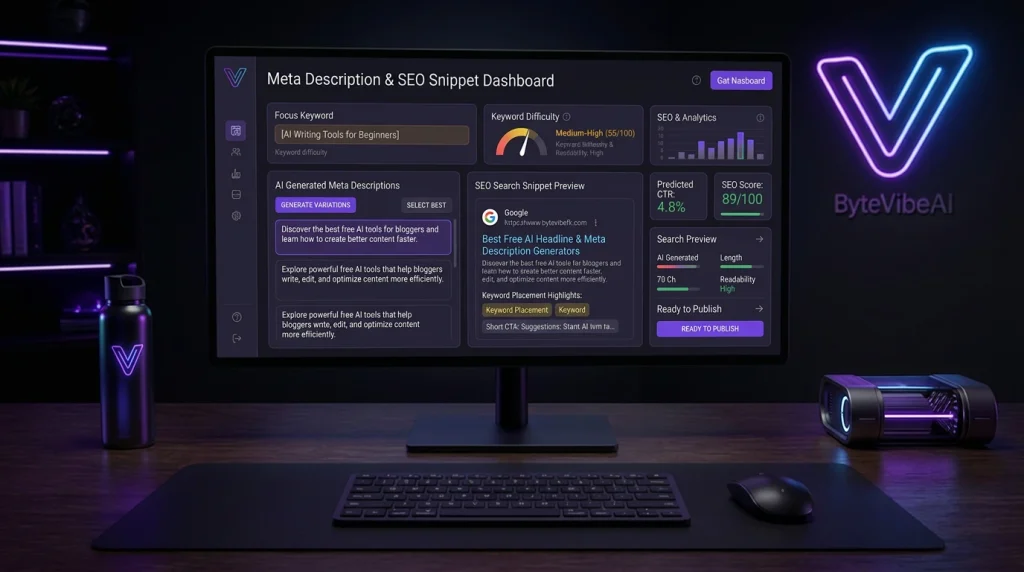
A useful meta description should give the reader a reason to continue.
You can mention:
What the article covers + who it’s for + what the reader can learn.
For example:
Discover the best free AI writing tools for beginners. Compare features, benefits, and simple ways to use them for faster content creation.
That’s more useful than a vague description such as:
Learn about AI writing tools and discover everything you need to know.
The first description tells the reader what they can expect.
Use Your Focus Keyword Naturally
For this article, the exact focus keyword is:
Best Free AI Headline & Meta Description Generators
It should appear naturally in important areas such as the title and introduction.
You can also use related phrases throughout the article, including:
- AI headline generators
- AI meta description generators
- free AI SEO tools
- SEO headline tools
- headline generator for blogs
- meta description generator
- improve CTR with AI
- SEO content tools
Don’t force these phrases into every paragraph.
Natural writing is more important than repetition.
A Simple Prompt You Can Reuse
If you regularly publish blog posts, save a prompt like this:
Create 10 SEO-friendly headline ideas and 5 meta descriptions for my article. Primary keyword: [KEYWORD]. Topic: [TOPIC]. Target audience: [AUDIENCE]. Keep the wording natural, specific, and useful. Avoid clickbait, keyword stuffing, exaggerated claims, and unnecessary words. Make sure the headlines accurately match the article.
You can change the information for every new article.
This gives you a repeatable process without making every headline manually from scratch.
Final SEO Check Before Publishing
Before publishing an article, spend a few minutes checking your search snippet.
Ask yourself:
- Is my primary keyword included naturally?
- Does the title accurately describe the article?
- Is the headline easy to understand?
- Does the meta description explain the benefit?
- Does the description match the actual content?
- Have I avoided keyword stuffing?
- Have I removed unnecessary words?
- Does the article satisfy the search intent?
- Is the URL short and relevant?
If everything looks good, you’re ready to publish.
FAQs About AI Headline & Meta Description Generators
Are AI headline generators free?
Some AI headline generators offer free access, while others provide limited free generations and reserve advanced features for paid plans. Always check the current limits before choosing a tool.
Can AI-generated headlines improve CTR?
A stronger headline can make a search result more appealing, which can improve its potential to attract clicks. However, there is no guarantee that an AI-generated headline will increase CTR because clicks also depend on search intent, competition, position, brand trust, and the actual content.
Is a meta description a Google ranking factor?
No. Meta descriptions are not considered a direct Google ranking factor. Their main purpose is to help describe the page and potentially make the search result more appealing to users.
Should I put my focus keyword in the meta description?
It can be useful when it fits naturally. Google may bold words that match a user’s search, making the relevant part easier to notice. But don’t force the keyword into the description if it makes the sentence unnatural.
Should I use AI-generated headlines without editing them?
It’s better to review and edit them first. AI can provide useful ideas, but you should make sure the final headline accurately represents your article and sounds natural for your audience.
Internal Links for ByteVibeAI
If you’re publishing this article on ByteVibeAI, connect it with your other AI Writing content.
Relevant internal links can include:
- Top Free AI Writing Tools for Beginners
- How to Use AI for SEO Copywriting
- AI Content Editing: Tools to Make AI Text Sound More Human
- How to Use AI to Rewrite Old Articles & Boost SEO Traffic
- Best Free AI Email Generators
These links can help readers discover related content and move through your website more easily.
Final Thoughts
The best Best Free AI Headline & Meta Description Generators can make the SEO writing process faster, especially when you’re stuck trying to create a strong title or search description.
But the tool should be treated as a starting point, not the final decision-maker.
Generate several ideas, compare them, check your focus keyword, and then edit the strongest option.
Most importantly, make sure your headline and meta description accurately represent your article.
A clear title may not sound as dramatic as clickbait, but it gives readers a better reason to trust your content.
If you’re building a blog, this small part of the publishing process is worth taking seriously. A useful headline gets attention, while an accurate description helps readers understand what they’ll find after clicking.
Start with the right keyword, create several options, edit them carefully, and publish the version that gives readers the clearest reason to visit your page.